Comments
posterguru, Ebay
ZAPPA ORIGINAL SHEET MUSIC SIGNED c.1958 (Item #163538793)
Original sheet music written and signed by Frank Zappa comes with a copy of the thank you letter sent to Frank for giving such a nice present. Guaranteed original and in great condition.
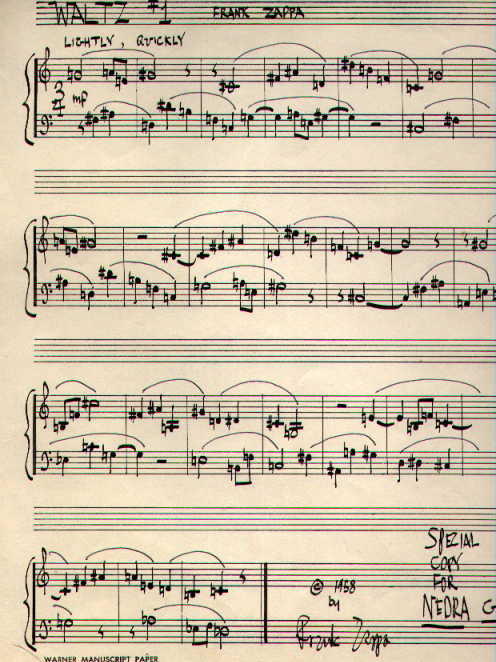
anonymous contributor
A midi rendition of the piece as it appears above.
Zappa!, Guitar Player Presents, 1992, p. 65, 72
"GUITAR WALTZ"
"This is a 12-tone crab canon written when I was 18. There's actually another version for two guitars, so it's a double crab canon. I don't know where it is though. I'd been doing 12-tone music for quite some time before I did this, but it was the first time I'd tried to write something for the guitar. I couldn't play it, and I never got to hear it until I got the Synclavier. And because it's printed on the Synclavier, that also means I got to push the button and listen to it. It's kind of short and boring."
—Frank Zappa
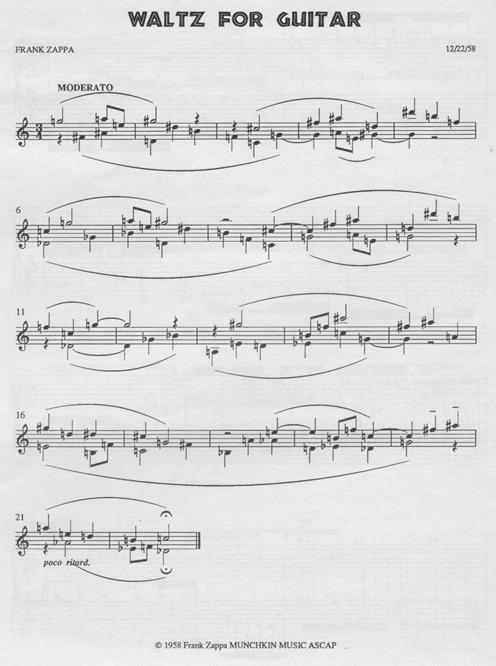
- There is a midi (with some wrong notes, as Michael Gula pointed out) of this piece at Cheepnis' site: http://freeweb.pdq.net/cheepnis/midi/Guitwalt.mid
"Waltz #1" vs. "Brown Shoes Don't Make It" 12-tone section
Michael Gula, alt.fan.frank-zappa, October 15, 2000
In the piano/vocal music, the notes which appear for the "We see in the back..." section [of "Brown Shoes Don't Make It"] are, in order: G#, G, B, A, E, D#, E, C, F#, and D. There are two "Es" there, but they belong to different octaves. The last "D" coincides with another appearance of "C". So there does appear to be a deliberate attempt to emulate the technique of the twelve-tone "style."
Biffy the Elephant Shrew, alt.fan.frank-zappa, October 15, 2000
As far as I can tell, the row is *supposed* to be G# G B Bb F A Eb E C F# C# D. Like the 12-tone "Waltz For Guitar," this passage consists of the row in its primary form over and over, with no transpositions, inversions or retrogrades.
Jon Naurin, alt.fan.frank-zappa, July 27, 2001
Subject: Re: What is FZ's "Waltz for Guitar?"
"We see in the back
Of the City Hall mind
The dream of a girl about thirteen
Off with her clothes and into his bed
Where she tickles his fancy
All night long."Or? Discuss.
Denis Griffin, alt.fan.frank-zappa, July 25, 2001
I thought I recognized it... It does make sense. I'm comparing page 72 of (Keyboard/Guitar Player Zappa special) and page 12 of (Frank Zappa Songbook), I'm not an expert but it does look very similar. Transposed?
Biffy the Elephant Shrew, alt.fan.frank-zappa, July 26, 2001
Yep. By a half step. The "Brown Shoes" row is:
G# G B Bb F A Eb E C F# C# D
The "Waltz" row is:
G F# A# A E G# D D# B F C C#
Both pieces simply present the row repeatedly, with no transpositions, inversions or retrogrades.
Michael Gula, alt.fan.frank-zappa, July 26, 2001
I think the two sequences are different. The apparant similarities are due to the three-four meter and the lack of a tonal center. Write your own twelve-tone row in three-four and it may evoke the "City Hall Mind" sequence just as much. The "City Hall Mind" sequence is quite a bit more sophisticated than Waltz #1.
"Brown Shoes Don't Make It," 12-tone section (thanks to Denis Griffin)
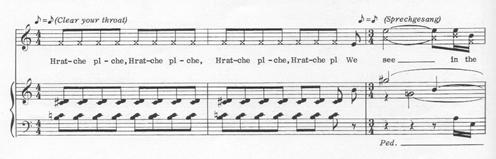
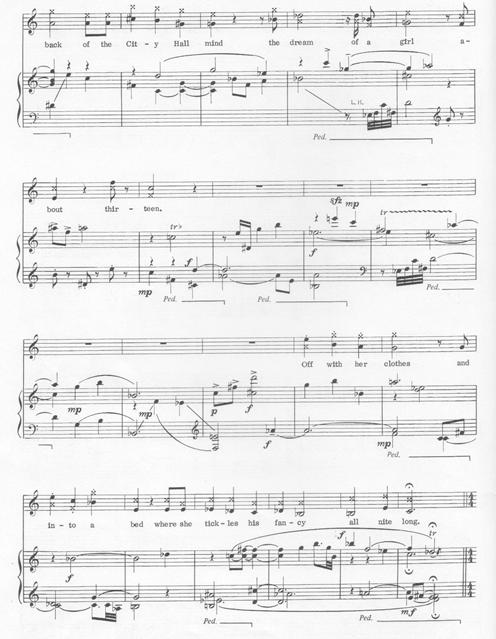
Additional informant: Dennis Griffin